Leave Your Message

How to Find Top Car Flood Lights Suppliers in China?

Finding dependable Car Flood Lights suppliers in China takes more than comparing prices or judging a bright showroom sample. Buyers need to examine beam patterns, housing seals, thermal management, wiring, and consistency between production batches. A lamp may look convincing on a workbench, then reveal uneven illumination or moisture inside after real-world use. That gap matters.

The opportunity sits within a larger market. Grand View Research’s Automotive Lighting Market Size, Share & Trends Analysis Report estimated the global automotive lighting market at USD 32.56 billion in 2023 and projected a 7.2% compound annual growth rate from 2024 to 2030. This broad category includes more than auxiliary flood lights, so it should not be mistaken for a Car Flood Lights market estimate. Still, it signals a competitive, evolving supply chain. Ask for proof: beam-pattern test results, material specifications, factory quality procedures, and clear warranty terms.

Expert attribution matters, too. No verifiable quotation from a named Car Flood Lights specialist was provided for this introduction, so inventing one would undermine its reliability. A practical sourcing principle is simple: verify claims against samples, records, and repeat orders. Even then, supplier documents cannot guarantee every batch. That is worth admitting. This guide will help buyers compare manufacturers, ask sharper questions, and identify risks before committing to an order.
How to Find Top Car Flood Lights Suppliers in China?

Define Your Car Flood Light Requirements

Before contacting car flood light suppliers in China, write down where and how the lights will be used. A work truck on muddy rural roads needs different coverage from a vehicle used for occasional campsite setup. Note the mounting location, available space, vehicle voltage, and expected operating hours. Measure the bracket area, too. A few centimeters can matter.

Describe the beam you need, not just a lumen target. A wide flood beam can illuminate nearby work areas, while a narrower pattern may reach farther ahead. Ask suppliers for beam photos, test data, and details about heat management.

Check the stated water and dust resistance, connector type, cable length, and resistance to vibration. Think about cold starts, rain, and mud. Real conditions vary. A specification sheet may not tell the whole story.

Request a sample and test its fit, wiring, light spread, and temperature after extended use. Your first requirements list may miss something; revise it after checking the light on the actual vehicle.
Identify Supplier Channels and Manufacturing Regions in China

For car flood lights, begin with supplier channels that reveal more than a polished product page. Chinese B2B directories can help build a shortlist, while automotive lighting trade fairs let buyers compare beam patterns, housings, and connectors in person. Ask whether the company designs and assembles the lights or mainly resells them. A factory address, production photos, and a clear answer about testing are useful starting points. Not proof, though.

Manufacturing activity is concentrated in several coastal areas. Guangdong, especially around Guangzhou, Shenzhen, and Dongguan, has dense electronics and automotive supply networks. Zhejiang, including Ningbo and Taizhou, is another area to investigate for lighting and component makers. These clusters can make it easier to source aluminum housings, wiring, and optical parts nearby. But a regional cluster is only a clue. Capabilities vary from one supplier to another.

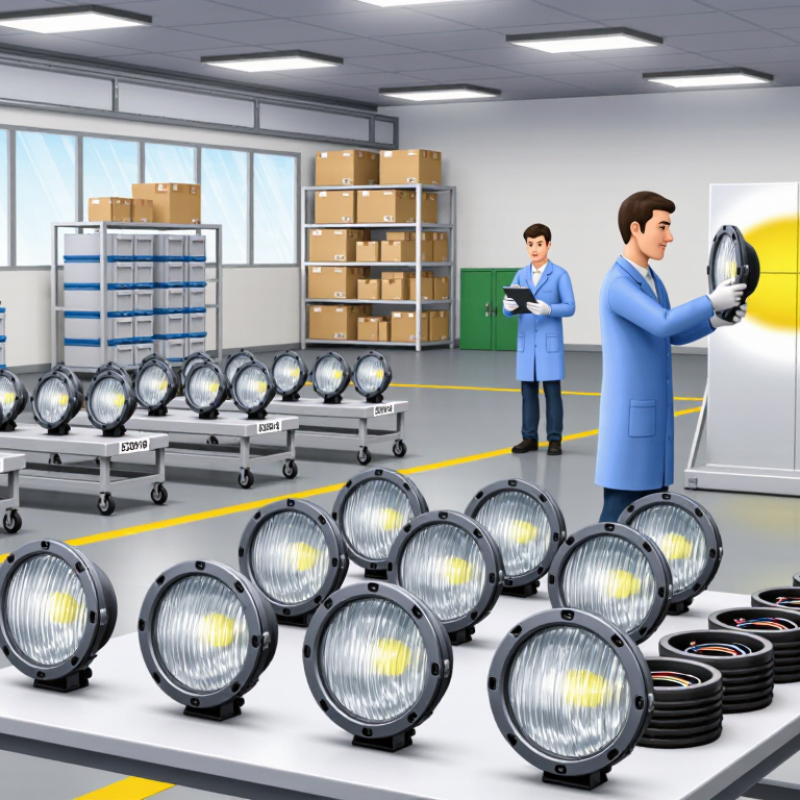
Before discussing large orders, request samples and check them under consistent conditions. Compare beam spread, heat management, sealing, cable length, and mounting hardware. Ask for test records and the stated ingress-protection rating, then confirm that the documents match the exact model. A brief video call can show assembly benches, labeling, and packaging, but it cannot replace an independent inspection. I would not rely on a glossy catalog alone. Small details matter. A supplier may answer slowly or provide incomplete drawings; note the gaps and ask specific follow-up questions before moving forward.

How to Find Top Car Flood Lights Suppliers in China?

Start your search in established automotive and electronics manufacturing hubs. The plotted points show approximate city-center locations—not supplier counts or a ranking of flood-light manufacturers.

Supplier channels: Use B2B marketplaces to build an initial shortlist, automotive and lighting trade fairs to meet suppliers, and local sourcing agents or industry referrals to identify factories. Verify manufacturing capability, product certifications, sample quality, and export experience before placing an order.

Verify Supplier Credentials, Experience, and Production Capacity

When evaluating car flood light suppliers in China, start with verifiable records, not a polished brochure. Ask for the company’s registration details, factory address, and quality-management certificates. Check that certificate numbers, issuing bodies, and validity dates can be independently confirmed. A document alone proves little. Request recent inspection reports for the specific lighting products you plan to buy.

Experience matters when a supplier can explain real production decisions. Ask how they control sealing, wiring, heat dissipation, and lens consistency. Request examples of past projects, with customer details appropriately protected. Then compare samples under the same conditions: inspect seals, connectors, beam spread, and visible finish. If a claimed ingress rating matters, ask for a test report that identifies the tested model and method. Reports can be easy to misread.

Production capacity needs evidence, too. Ask how many units the line can make weekly, what equipment is in-house, and which processes are outsourced. A factory tour, live video walkthrough, or recent production records can help verify the answers. Discuss peak-season orders, component lead times, and how defects are recorded. Small discrepancies deserve a question, not an accusation. Capacity on paper may not match a busy factory floor. I would also ask what happens when an order falls behind, because that answer can reveal more than a sales presentation.

Assess Product Quality Through Specifications and Samples

Request samples before comparing car flood light suppliers. A specification sheet should state input voltage, power draw, measured light output, beam pattern, color temperature, and ingress protection rating. Numbers need context. Ask how output was measured, and whether the beam was tested on a vehicle or only on a bench. A high lumen claim alone says little about useful road coverage.

Inspect the sample closely. Check the housing seams, lens clarity, cable length, connector fit, and mounting points. Then run the light at its rated voltage and note current draw and heat after 30 minutes. Compare beam spread on a wall at a fixed distance; look for dark patches, glare, and uneven edges. Small flaws show up here. If practical, repeat the test after vibration and controlled water exposure, using the same conditions for each supplier.

One sample is not proof of consistent production. Request samples from different batches when order volume justifies it, and compare labels, finish, and performance. Keep photos and test readings with the supplier’s quoted specifications. A polished datasheet can still omit useful details, so ask direct questions and record unclear answers. Even careful testing has limits: your setup may differ from actual vehicle use. That is worth acknowledging before choosing a supplier.

How to Find Top Car Flood Lights Suppliers in China? - Assess Product Quality Through Specifications and Samples

Assessment area What to request from the supplier How to check the sample Useful acceptance evidence
Electrical input Rated voltage, operating-voltage range, current draw, and polarity protection details. Run the light from a regulated power supply at the stated operating voltage; record current and check for flicker or abnormal heating. Measured results agree with the datasheet. Confirm whether the product is designed for a 12 V system, a 24 V system, or both.
Light output and beam Lumen and candela data, beam pattern, color temperature, and the measurement method used. Compare samples on the same power supply and use a light-measurement setup or an independent photometric test. Inspect beam shape on a target at a fixed distance. A photometric report identifies the tested model and method. Treat lumen figures as comparable only when test conditions are consistent.
Ingress protection The claimed IP rating and a test report for the complete lamp assembly, including cable entry and connectors where applicable. Review the report and inspect seals, joints, cable glands, and lens bonding. Do not treat an informal spray test as certification. A report referencing IEC 60529 and the exact tested configuration. IP67 or IP68 claims should be supported by the applicable test conditions.
Thermal performance Operating-temperature range, thermal protection behavior, and any continuous-operation test results. Operate the sample in a ventilated setup for a defined period; monitor input, light output, and accessible housing temperature. Documented test duration and ambient conditions, with no unexpected shutdown, flicker, or visible damage.
Vibration and mounting Mounting instructions, fastener specifications, and any vehicle-environment vibration test report. Check bracket rigidity, fastener fit, connector retention, and whether the beam aim shifts after a suitable vibration test. A report stating the test setup and referencing relevant road-vehicle environmental test methods, such as ISO 16750-3 where applicable.
Corrosion resistance Housing and bracket materials, surface finish, and salt-spray test details if corrosion resistance is claimed. Inspect coating coverage, cut edges, fasteners, and dissimilar-metal contact points for defects or early corrosion. A test report with exposure duration, evaluation criteria, and reference to ISO 9227 when a salt-spray test is used.
Automotive EMC Conducted and radiated emissions or immunity results relevant to the intended vehicle installation. Confirm the tested lamp, driver, wiring, and operating mode match the supplied configuration; check for interference during installation trials. Applicable test reports may reference CISPR 25 for vehicle radio-disturbance measurements and ISO 11452 methods for component immunity.
Sample-to-order consistency A controlled datasheet, bill of materials or component specification, and written confirmation of production configuration. Record sample identifiers and compare connector, cable length, housing, labels, accessories, and measured performance with the approved specification. A signed sample approval record and clear change-control process for any component or design substitution.
Supplier quality controls Quality-system documentation, inspection plan, traceability method, and handling of nonconforming products. Ask how incoming components, finished lamps, and outgoing orders are inspected and how production lots are identified. Verifiable, in-scope quality documentation and inspection records; confirm certificate scope and validity with the issuing body when needed.

Note: Standards and test methods should be selected for the product, installation, and destination market. Request reports for the exact model and configuration under evaluation.

Compare Pricing, Communication, and Delivery Terms

How to Find Top Car Flood Lights Suppliers in China?

Compare Pricing, Communication, and Delivery Terms

A useful supplier comparison starts with matching specifications, not just unit prices. Ask each supplier to quote the same beam pattern, housing material, light output, cable length, and water-resistance rating. Request an itemized offer covering tooling, packaging, sample fees, and shipping. A low quote may exclude costs that appear later. Details matter.

Communication is part of the evaluation. Send a short, specific inquiry and note whether the reply answers each question clearly. Ask for product drawings, test reports, and photos of the actual flood light, not only a polished catalog image. Confirm who will handle technical questions and how quickly changes to a sample can be discussed. One slow reply is not conclusive, but repeated vague answers deserve attention. Keep records.

Delivery terms need the same scrutiny as price. Confirm the production lead time, inspection schedule, packaging method, and named shipping arrangement in writing. Clarify whether the quoted delivery date begins after deposit, sample approval, or final specification approval. Ask how delays are reported and what happens if inspection finds a defect. Build in a modest time buffer; schedules can slip, and a spreadsheet rarely captures every production snag. Recheck the final quotation against the agreed specifications before placing an order.